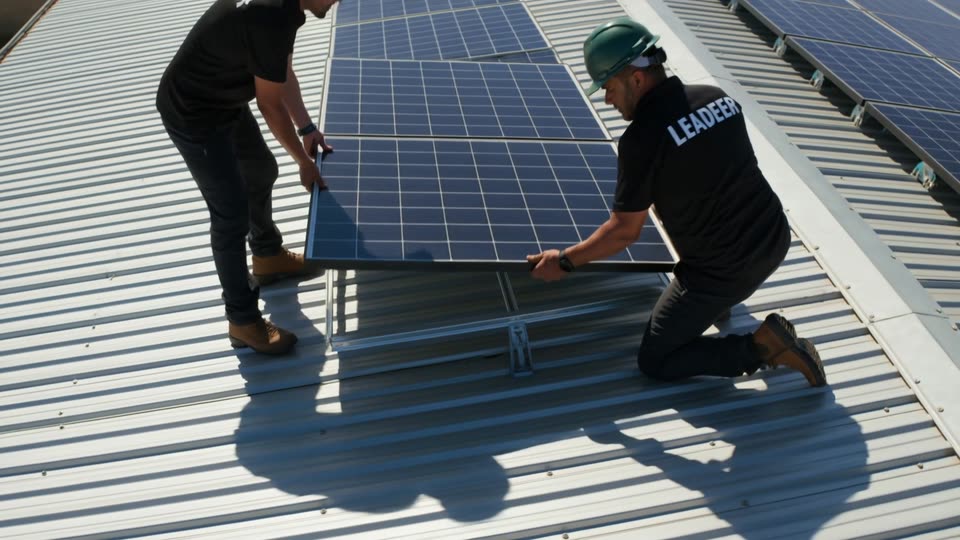
Industrial Solar Cape Town covers large solar PV and battery systems for manufacturing plants, processing facilities, distribution centres, cold storage and industrial parks - sites where electricity is a production cost, not an overhead. Compare quotes from installers set up for industrial-scale projects.
Industrial sites suit solar well. Big sheeted roofs, heavy weekday daytime loads and high consumption make systems of 200 kWp to several MWp both practical and quick to pay back.
Share 12 months of bills, your notified maximum demand and shift pattern, and installers can scope a system.
Compare Industrial Solar QuotesIndustrial Load Profiles
| Facility | Typical load pattern | Solar fit |
|---|---|---|
| Manufacturing, day shift | Heavy 7am - 5pm weekdays | Excellent |
| Manufacturing, 24-hour | Flat load, day and night | Good for daytime share; BESS for more |
| Food and beverage processing | Refrigeration plus process heat and pumps | Very good |
| Cold storage | Continuous compressor load, peaks on hot afternoons | Very good - demand peaks with the sun |
| Distribution centres | Lighting, conveyors, forklift charging, offices | Good; weekend export needs planning |
| Industrial parks | Mixed tenants across several buildings | Good with the right metering structure |
Demand Charges And Peak Shaving
Industrial accounts pay for energy (kWh) and for the highest demand recorded in a billing period (kVA). Solar reduces energy charges reliably. It does not reliably reduce demand charges on its own - a cloud passing at the wrong moment, or a compressor starting after sunset, sets the peak regardless.
Peak shaving uses a battery energy storage system (BESS) controlled by an energy management system to discharge when site demand approaches a set threshold. It is covered in detail on Commercial Battery Storage Cape Town.
- Motor starting. Large motors draw several times their running current on start. Soft starters and VSDs help before storage does.
- Power factor. Poor power factor raises kVA demand. Power factor correction is often cheaper than batteries for that part of the problem.
- Notified maximum demand. Solar does not change your contracted capacity with the City or Eskom.
Rooftop, Ground-Mount And Carports
- Large rooftop systems. The default on industrial sheeted roofs. Structural checks on older portal frames and purlin spacing are essential, and roof condition should be addressed before installation.
- Ground-mounted solar. Suits sites with spare land, or where the roof is weak, leased or near end of life. Fixed-tilt or single-axis tracking structures, with fencing, security and stormwater considered.
- Carports. Turn staff and truck parking into generation and pair naturally with EV charging.
Three-Phase Integration And Generators
Industrial systems connect at the main low-voltage board or, on larger sites, on the medium-voltage side through transformers. Most industrial sites also have diesel generators. Integrating solar with a generator lets the system reduce fuel burn during outages, but it needs controls that stop PV from reverse-powering the generator and that keep generator loading within the manufacturer's minimums.
Industrial Solar Cape Town Prices
| Project | Indicative installed range, excl. VAT |
|---|---|
| 200 kWp rooftop grid-tied | R1,900,000 - R2,700,000 |
| 500 kWp rooftop grid-tied | R4,500,000 - R6,500,000 |
| 1 MWp rooftop grid-tied | R8,500,000 - R12,500,000 |
| 1 MWp ground-mount, fixed tilt | R9,500,000 - R14,000,000 |
| 250 kW / 500 kWh BESS | R2,100,000 - R3,500,000 |
| 500 kW / 1 MWh BESS | R3,800,000 - R6,500,000 |
| Generator integration controls | R60,000 - R250,000 |
Excludes roof replacement, medium-voltage work and transformer upgrades, which are quoted separately.
Industrial projects vary widely in scope. Compare full proposals, not headline prices.
Compare Industrial Solar QuotesCompliance For Larger Systems
- SSEG authorisation from the City of Cape Town, or the relevant distributor, before installation. Systems up to 1 MVA fall under the City's SSEG framework.
- NERSA registration for facilities above 100 kW with a grid connection.
- Engineering sign-off. An ECSA-registered engineer's design and commissioning documentation.
- Certificate of Compliance for the electrical installation.
- Health and safety. Working-at-height compliance, fall protection plans and site inductions.
- Insurance. Insurers may ask for fire, battery and roof-access details.
See Commercial Solar SSEG Registration Cape Town and confirm current requirements with your distributor.
Funding Industrial Projects
Section 12B allows a 100% first-year deduction for solar PV up to 1 MW and 50/30/20 over three years above that. Many industrial operators prefer to keep capital for production and use a power purchase agreement instead. Medium-voltage users with multiple sites can also look at wheeling.
Industrial Areas
Industrial installers regularly work across Montague Gardens, Paarden Eiland, Epping, Airport Industria, Blackheath, Killarney Gardens, Stikland and Brackenfell. Facility-specific detail is on Solar for Factories Cape Town, Solar for Warehouses Cape Town and Solar for Business Parks Cape Town. Ongoing performance tracking is covered on Commercial Solar Monitoring Cape Town.
The installation process is outlined on Commercial Solar Installation Cape Town.
Frequently Asked Questions
Can a factory run on solar power?
A factory can meet a large share of its daytime energy from solar, but running entirely on solar is rare. Most industrial systems work alongside the grid, with batteries and generators covering nights and outages.
Does industrial solar reduce demand charges?
Not reliably on its own. Demand peaks can occur when solar output drops. Controlled battery storage is used to shave peaks.
How big can a rooftop industrial solar system be?
Limited mainly by roof area, structure and export rules. Rooftop systems of 500 kWp to 1 MWp and more are common on large warehouse and factory roofs.
Is ground-mounted solar better than rooftop for industry?
Ground mounts avoid roof loading and lease constraints and are easier to maintain, but need land, security and more civil work. Rooftop is usually cheaper where the roof is suitable.
Does an industrial system need NERSA registration?
Grid-connected facilities above 100 kW register with NERSA, in addition to approval from the local distributor.
Can industrial solar work with a diesel generator?
Yes, with proper controls. The system must prevent reverse power into the generator and keep generator loading above its minimum.
What payback do industrial sites see?
Heavy daytime users often see simple payback in the region of 4 to 6 years on grid-tied systems. Nights, weekends and export limits lengthen it.
How long does an industrial solar installation take?
Several weeks on site for a few hundred kWp, plus design, engineering and approvals beforehand. Large projects can take months from first survey to commissioning.
Related Commercial Solar Pages
Commercial Solar Installation Cape Town is a free quote-comparison service. The solar work is carried out by the independent installers that quote you, and your contract is with the installer you appoint. Ask each installer for company details, references, insurance cover and their compliance paperwork before appointing anyone.
Industrial Solar Cape Town. Compare proposals from installers equipped for industrial-scale solar and storage.
Get 5 QuotesGet Industrial Solar Cape Town Quotes
Send your bills, maximum demand and operating hours, and industrial solar installers will quote directly.
Free to use, no obligation. Your request goes to LEADERR APPROVED commercial solar installers covering your area, who quote you directly.
Client Reviews
Powered by leaderr